Free UK Delivery on all orders over £20
HOW BLOCK? The PROCESS OF MAKING CIVIL BLOCK SOAP


Wonder how such a top notch BLOCK is made?

EMULSIFY
MONITOR
CUT
CURE
WRAP

Wonder how such a top notch BLOCK is made?
Let’s go on a Fred Dinenage inspired journey…


Our master soapmakers know their stuff. They take these raw materials, accurately measure, heat + emulsify them.
It’s making mayonaise on steroids.
1) OILS + ALKALI
Using a carefully blended selection of plant based oils not only ensures each BLOCK is Natural, Vegan + Eco Friendly, but using each oil to their strength negates the need to use chemicals to ‘fix’ cr*p soap.
The Alkali solution is prepared by dissolving NaOH (a sodium, an oxygen and a Hydrogen atom made from electrolysed seawater) with H2O distilled on site.
2) COALS + CLAY
The personality of each BLOCK develops with the choice of natural ultra fine coal + clays that are suspended in the emulsion.
Ultimately, clays work with the oils to create a distinctive polishing lather that is thick, holds up and deodorises for a smooth gentle clean.
It's all about the Ingredients

3) NOURISHMENTS + EXFOLIANTS
We supercharge our BLOCKS with a variety of additional nourishments for feeding the skin such as Raw Cacao, Turmeric + Nettle. Full of vitamins, anti-oxidants or roughage, we take great soap to the next level.
Nettle and Oatmeal give their BLOCKS a gentle texture which polishes the skin. Others, such as BREEZE BLOCK is dense with fine pumice powder for a full on sanding!
4) DISTILLED PLANT EXTRACTS
We do not touch the synthetics and cheap chemical fragrances that the industry is laden with. CIVIL BLOCK only used 100% essential oils. Synthetics give a strong scent, but add nothing else but unnecessary chemicals.
Essential Oils on the other hand are much more subtle + sophisticated. They have been used medicinally for centuries, from being more alert, to actively clearing skin conditions.
Powerful in each of their own ways, there is a half a bottle of essential oil in each BLOCK. When making a batch, it amounts to a fair wad of the stuff.
It's all about the temperature
Emulsifying the raw ingredients is only the first step. As with every part of the process, temperature is critical. The soapmakers prepare warmed moulds, and when the emulsion starts to thicken, they wap it in.
A constant low heat is applied that forces the natural saponification process (the changing of Oil + Alkali to soap) to complete in a controlled environment.
When the conditions are just right, the soap begins to increase in temperature to the point where it reaches nearly 85ºc.
It’s pretty mental stuff eh? Don’t get anywhere near it at this point – if the pH doesn’t burn you that searing heat will!
During this process, the consistency becomes gelatinous and translucent, the colours become strikingly bold and the pH level drops.
All of this is important so the resulting BLOCK structure becomes harder, glossy, longer lasting and better performing.
After monitoring that the secondary heat process has finished, the pH has a final reading to confirm it is completely saponified, and the soap is insulated for a further 12 hours to form.

24 hours after the raw ingredients were emulsified, we have soap!
Whilst still warm and maliable, our soapmakers process the batch of soap by using cutting tools to exactly size each BLOCK.
Once cut, the soap will cool rapidly and harden further.
It's all about the finish
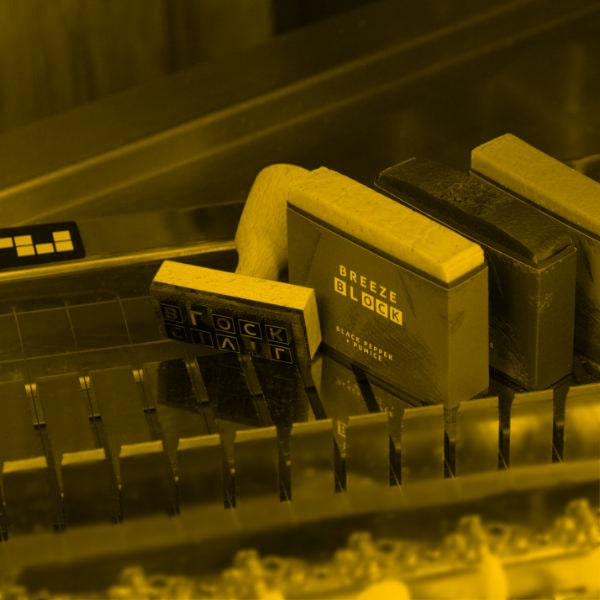
Before that happens, custom stamps are used to emboss each BLOCK with our logo – your guarantee of the quality.
The last thing our soapmakers do at this stage is log all but what they had for breakfast – dates, ingredients, producers and batch numbers.
If one producer of Oil, Clay or Essential Oil makes a better BLOCK, we want to know!
If you want to know the origin of one ingredient – we can tell you!
It's all about the Age
Ever thought of a good soap like a good whiskey?
Theres more similarities than you might think.
All BLOCKS have batch numbers assigned. They are tagged and set to air cure for a minimum of 28 days.
For the best result, the soap is kept out of the light and turned every 48 hours to promote even, gentle curing. During this time, remaining distilled water dries out, it shrinks, and gets harder.
It’s not just the water content that changes, but the slowly developing soap crystal structure.
Think back to the gelatinous stage where the emulsion is translucent. It becomes opaque because of tiny crystals forming, like salt water left in the sun.
Once the Mature Date is met, they look a little smaller, but the performance has improved enormously. The tightly knit crystals disolve much slower when you use it, yet lather and clean much better. No commercial soap has a patch on this.
Like a good whiskey, it gets better with age.
Good whiskey, on the other hand, is gone before you know it…

Bespoke tools are used to cut and fold UK Made Recycled Black Card into our protective wraps and boxes.
Made on site to exact specifications.
Without swathes of plastic, each BLOCK finishes it’s journey at the packing station.
It's all about the Result

Manufactured within 8 miles of the microsoapery, we use the best cardboard for packaging with the lowest carbon footprint we can.
It is cut and folded on site to perfectly fit each BLOCK, offering excelent protection without the need of wasteful packing.
Simple, safeguarding and effective.